Why Domain Expertise is Crucial for Your Logistics AI Tech Stack


From chatbots bolted onto TMS platforms to yet another workflow orchestration agent promising “productivity gains,” the logistics industry has become flooded with AI solutions. Many teams feel overwhelmed by promises of transformation and unsure which tools can deliver real operational value.
Most of these new systems are built on general-purpose AI models that do not understand how freight truly works. They can generate fluent responses, summarize emails, and draft rate confirmations, but they cannot grasp the nuance, urgency, or operational logic that drives real-world logistics decisions.
In freight, nuance is everything. It shapes how exceptions are handled, how relationships are managed, and how money is made or lost. Below, I break down why domain expertise is essential for AI-powered logistics operations.
Freight Is a Language of Its Own
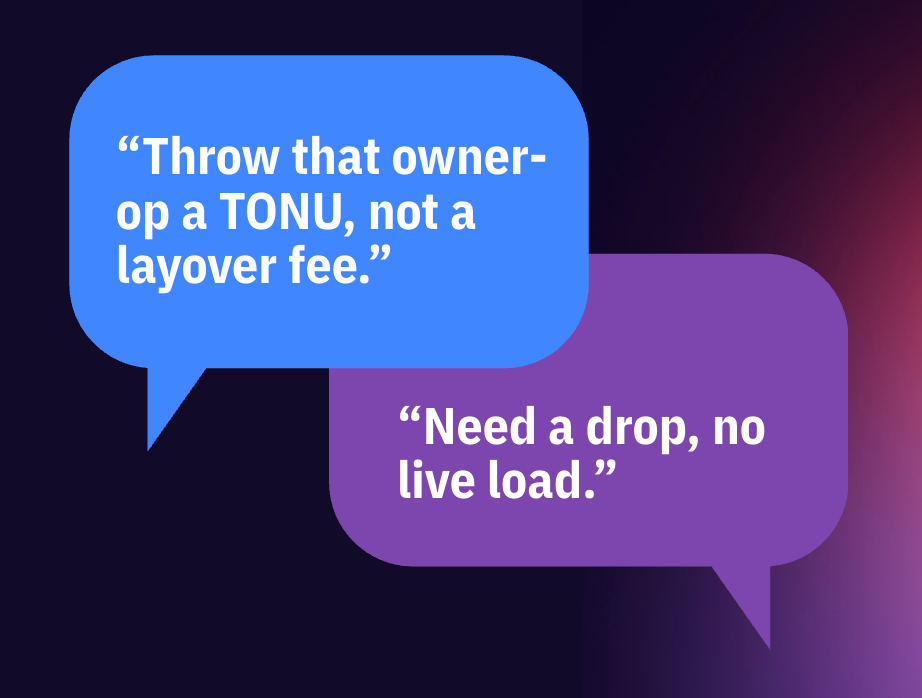
Logistics is not just data moving between systems. It requires a working freight language built on shorthand, exceptions, timing pressure, and tribal knowledge that lives in people’s heads and habits. After a seven-year hiatus from a freight brokerage floor, I came back and heard: “throw that owner-op a TONU but not a layover fee. Also, need a drop, no live load—oh, and pre-cool the trailer!” I was suddenly reminded of the “Logistics language” that only an operator can truly love and understand…until now.
Step onto a brokerage floor and you feel it immediately. Conversations move fast. Sentences get cut in half. Meaning is carried as much by tone, urgency, and hand motions as it is by the words themselves. Everyone in the room knows what matters and what can wait. It’s a living language.
Terms like lumper fee, detention versus layover, TONU, accessorials, and drop versus live load are not just labels. They are operational triggers. Each one implies a set of rules, financial implications, and next steps that experienced operators understand instinctively.
A generic AI model might recognize these words as “logistics-related,” but it will not understand what actually needs to happen when one of them shows up in a text message, an email thread, or an EDI update. As one of the many systems of record, it might appropriately surface the information to the operator, pushing out yet another update in a sea of notifications. But it remains highly ineffective at guiding the operator to deliver an outcome, i.e. act as a true “decision layer.”
This gap creates real consequences. It can mean approving a lumper incorrectly, disputing detention that should be paid, missing a TONU claim window, or routing a load wrong because “drop” was interpreted as a place instead of a load type.
For human operators, this fluency comes from immersion. Logistics knowledge is accumulated by running freight day after day, watching how issues unfold, and internalizing what works.
This is also why AI observability and AI copilots are such a breakthrough for operators. You no longer have to be always on or constantly tied to your keyboard. With an army of assistants working under you, monitoring messages, interpreting events, and escalating the right things, you gain leverage without losing control.
But that only works if the AI actually speaks the language of freight.
What is “Logistics-Trained AI?”
There’s a massive difference between AI that has seen logistics data and AI that understands logistics workflows.
Most generic models fall into the first category. They’ve been exposed to freight-related text somewhere in their training data, but they don’t understand how that information connects to decisions, exceptions, and next actions.
“Logistics trained” means grounding AI in the actual structure of how logistics work gets done. A truly logistics-trained system is built on three foundations:
- Industry-specific terminology, not just as vocabulary, but as operational signals that trigger real actions
- Real freight conversations across brokers, carriers, and shippers, capturing how work actually unfolds in practice
- End-to-end workflows that reflect how a load really moves, from tender to pickup to delivery to invoicing
With this foundation, an AI agent can understand sequences, dependencies, and operational consequences. It can reason about what just happened, what usually happens next, and what should happen now.
The practical result is immediate usability. Instead of months of prompt engineering and brittle rule-building, teams can work with a system that already “thinks” in logistics terms and aligns naturally with real operational behavior.
From Words to Workflows: Understanding How Freight Really Moves
Freight decisions are rarely simple or isolated. For example, a delay is often more than just a delay. It can trigger detention, shift appointment windows, change driver availability, disrupt downstream loads, and spark a dispute all at once. Each event sets off a chain of consequences that operators have to manage in real time.
A logistics-trained AI agent not only recognizes what happens, but understands what usually happens next.
This requires embedded operational logic, such as knowing when detention is valid versus disputable, how lumper fees are typically handled, how timing and location shape the right response, and why the same exception might be treated differently depending on the customer, lane, or contract.
An AI agent that can recite detention rules is not useful if it does not know when to escalate, when to wait, and when to act automatically. Real freight expertise is about understanding sequences, dependencies, and the practical consequences of each choice.
The Logistics Context Graph: How Intelligence Compounds Over Time
There has been a lot of excitement about context graphs lately, and for good reason.
Systems of record only capture final states. A load was delivered. An invoice was paid. A ticket was closed. But the real work of logistics happens long before that, across email threads, TMS notes, appointment portals, phone calls, internal messages, and exception escalations.
Lasting progress in freight AI comes from understanding how work moves through real operations. Much of the reasoning behind decisions will always live in human judgment, experience, and tradeoffs. What can be modeled is the structure of the work itself: how activity flows across tools, how decisions build over time, and how issues stall, recover, and eventually resolve.
A logistics context graph captures those patterns. It links terms, actions, outcomes, and exceptions into a living map of how freight operations actually function. It reflects not just what happened, but how things unfolded and what typically follows.
Over time, this understanding compounds. Each interaction adds clarity. Each edge case sharpens the system’s judgment. Each resolved issue becomes a reference point for future decisions. That aggregation of operational knowledge is what creates real defensibility.
The Future of Freight AI: From Software to Infrastructure
For brokers, carriers, and operations teams, logistics-trained AI changes how work feels. It reduces manual correction and re-explaining, lowers the cognitive load of adoption, and cuts down on costly mistakes caused by misinterpretation.
It feels less like managing a chatbot and more like working alongside a seasoned team member—one that can handle real operational work and surface the right issues at the right time. The result is leverage without sacrificing control.
Looking ahead, logistics-trained AI will become infrastructure: the invisible layer that coordinates communication, decisions, and execution across the freight ecosystem. Rather than a nice-to-have add-on, it will be integral to how freight moves.
For this layer to take shape, domain expertise is crucial. Without it, automation breaks down. With it, trust forms. And in freight, trust is what moves loads.