The Power of Memory: How Envoy’s Shared-State Architecture Beats Siloed Automation


For years, automation has been sold as a remedy for overloaded operations teams and shrinking margins in freight. It promises fewer phone calls, faster data entry, and less manual work. On paper, it all makes sense. In practice, automation often breaks down the moment real-world complexity shows up.
The tools are effective, but they don’t work together. Each tool does its own narrow job, with no awareness of what the others are doing. A call bot confirms appointments. A tracking widget monitors ETAs. A data-entry platform updates the TMS. Each one technically succeeds, but the execution still feels messy.
That’s the hidden ceiling of automation. You can automate all the steps, but that won’t lead to smoother operations. Automation without shared memory is just faster fragmentation.
The Problem with Siloed Automation
Most traditional automation is built in silos. One bot per task. One workflow per system. One narrow definition of success per tool. Everything between those tools is left to humans to reconcile.
This is where things break down. Context gets lost between calls, emails, and systems. Work gets duplicated because tools don’t know what already happened. Actions conflict because bots are operating on stale or incomplete information. Humans get pulled back in to stitch together what the automation was supposed to handle.
Here’s one simple example: A call bot confirms a delivery appointment with a carrier. The conversation is logged, but the TMS never gets updated. The tracking system still thinks the load is unconfirmed, and a human must step in to fix it. Nothing technically failed. The system just wasn’t designed to share context.
Why Memory Changes Everything
In my experience running brokerage operations, the highest-output carrier reps had the strongest memories. Shadowing a top performer felt like watching a conductor at Carnegie Hall, effortlessly recalling every lane, carrier preference, and past conversation while moving at full speed. That kind of operational fluency has always lived in a person’s head, which is why it’s been so hard for software to truly replicate.

In AI-driven operations, memory is what creates persistent, shared understanding across the entire operation. The difference between independent task execution and context-aware operational intelligence is the ability to remember what’s been done, what’s pending, what changed, what rules apply, and what still needs action.
Memory is built through a context graph. A context graph is the structured, evolving representation of how work actually moves through your operation. It captures loads, carriers, calls, commitments, exceptions, system updates, and outcomes in a single shared model and turns isolated actions into coordinated work.
It’s also why AI data collection from domain experts is so critical. Every interaction, decision, and outcome feeds that context graph. The richer and more accurate the data becomes, the smarter and more reliable the system gets.
Building Memory: The Shared-State Architecture
A shared-state architecture is one that orchestrates multiple intelligent agents with shared memory. In plain language, it’s one operational brain with many specialized hands. This is the architectural model Envoy AI uses to power Ellie, our carrier operations agent that lives in your browser.
Think of it as a form of hive-mind intelligence. Each agent focuses on a task. One handles calls, one handles data entry, one handles tracking, one handles exception recovery, etc. All of them read from and write to the same operational context.
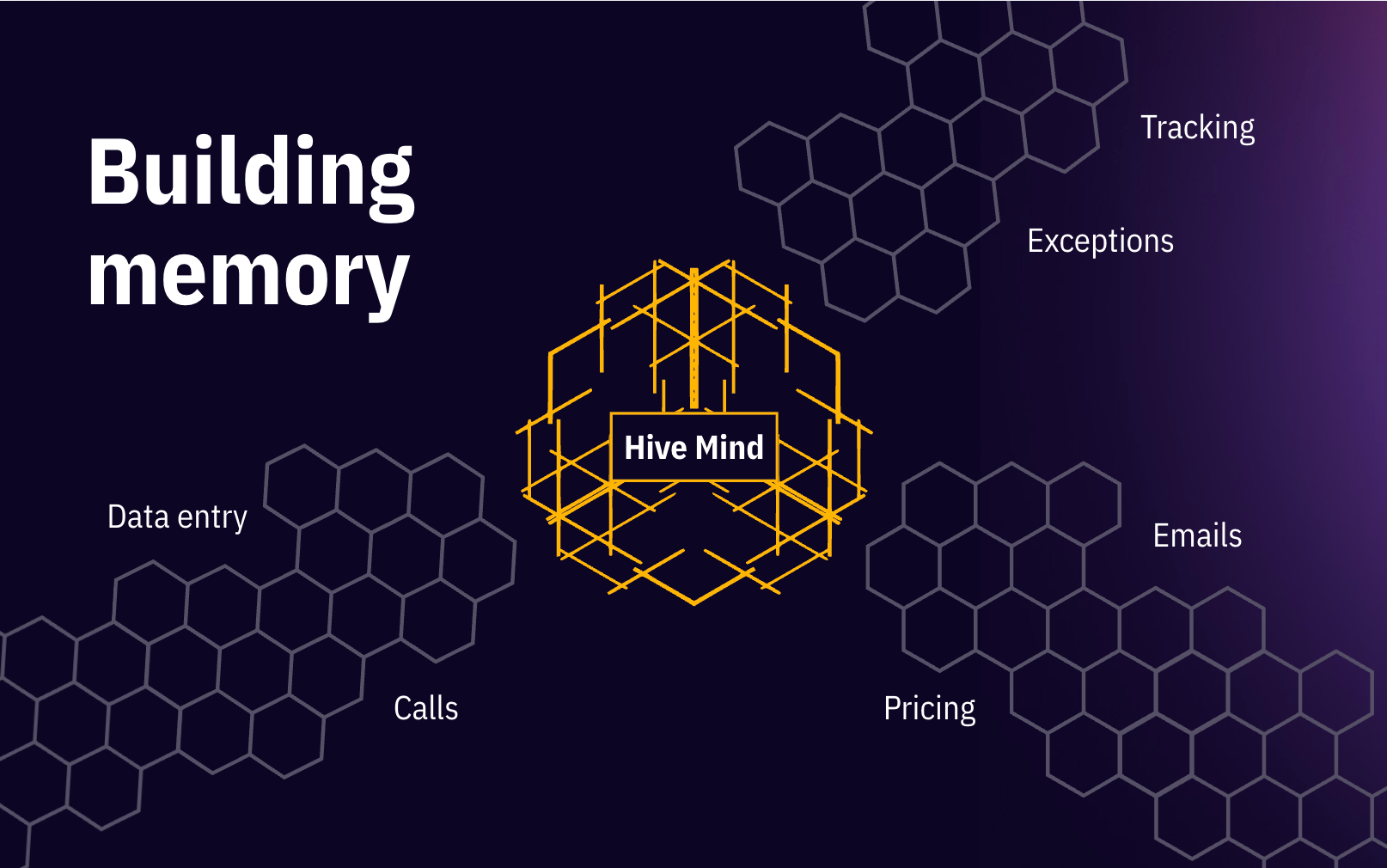
That shared state includes load details, carrier history, call outcomes, exceptions, pending actions, deadlines, and system updates across tools. When one agent learns something new, the rest of the system knows it instantly.
Crucially, Ellie’s behavior is structured and repeatable. Teams can define standard operating procedures using a domain-specific scripting language, and Ellie will reliably follow those steps every time. At the same time, she’s infused with real-time reasoning. A large language model brain lets her make judgment calls, converse naturally, and adapt when something unexpected happens.
That fusion of deterministic workflow and intelligent reasoning is a key differentiator. You get the consistency of software and the adaptability of AI in one system.
Multi-Tasking at Scale: One Brain, Many Hands
This coordination shows up most clearly when work scales.
Imagine 100 carrier calls happening in parallel. As each call completes, the outcome is written into the shared state. The TMS is updated in real time. Follow-up actions are automatically triggered. Exceptions generate recovery workflows. Customers are notified if delivery times change.
Because every agent is operating on the same memory, nothing slips through the cracks. When one part of the system updates a load or detects an issue, the others immediately know. It feels less like automation and more like an operations team that never drops a ball.
Parallelism without shared memory leads to conflicting updates, double-booked appointments, stale data, and overwrites. Shared context avoids those collisions and compounds both speed and accuracy. More loads managed per person. Fewer manual interventions. Higher trust in outcomes.
What This Means for Ops Teams and Brokers
For operations teams, shared-state AI changes the nature of work. There are fewer handoffs and fewer interruptions. Efficiency drastically increases. Operators begin to fully trust their automated systems. Humans move from task execution to exception oversight.
Instead of chasing updates and fixing gaps, teams supervise a coordinated system that actually understands what’s happening.
Shared-state AI turns automation into coordination. When systems remember what’s happened and act on that shared context, operations stop feeling fragmented and start feeling dependable.
If you're interested in learning more about how we are leveraging shared state AI and agentic memory to optimize your operations, click the link below.